

 Inspirada
 Sloan Canyon
 Springs
 St Rose
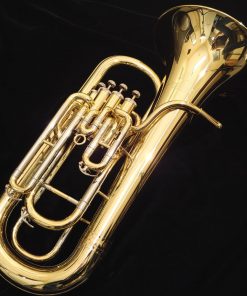
Kessler Custom Artist Series Euphoniums
Professional Performance, Student Price

The Kessler Custom Artist Series Euphoniums were designed to give players the advantage of a professional bore and design from day one. By eliminating middlemen and designing our horns directly with the factory, we provide an instrument that is easier to play, sound better instantly, and – unlike standard student & intermediate models – won’t need to be replaced as the player advances.
Performance
The “Pro Bore” Advantage
Most student and intermediate euphoniums use a small bore that feels “easy” at first but limits sound quality and volume as the player grows. This forces you to upgrade expensive instruments sooner.
We took a different approach. All Kessler Custom Euphoniums feature a Professional Bore and Overall Design. So regardless of the model you go with, you can rest assured that the instrument will not hold you back!
- Rich, Warm Tone: Gives the player the best sound possible from breath one.
- No “Ceiling”: The instrument grows with the player’s skill.
- Easier Transitions: Students won’t have to relearn air support when they move to a “pro” horn.
Quality
All of our Kessler Custom Artist Series Euphonium models are made side by side in the same facility. This factory partner has exceptional workmanship with tolerances of assembly that are higher than almost anything on the market. Every horn is still completely gone through in our ProShop to ensure that the instrument is in perfect working order and ready to amaze with the first note. We ensure that all tuning slides are fit properly and smooth (though we rarely have to make an adjustment as the factory fit is excellent) and that valves are setup for optimal performance. We setup all of our horns with a premium light weight synthetic oil (LaTromba T2 is our favorite) for great action and durability. Finally, each horn is paired with a German made CNC precision made FAXX 51D mouthpiece.
Affordability
This is the linchpin of the whole operation! The lineup of Kessler Custom Euphoniums offers a price point that is commonly associated with only entry level student models that do not share in the feature, performance, and in many cases the quality level being offered.
In the end, euphoniums, even student models, are not cheap. The combination of performance and quality at a student accessible price makes our lineup the most impressive value on the market.
Kessler Custom Euphoniums
Kessler Custom Euphonium Lineup
Meet the full lineup of our Euphoniums! All of the models feature the same professional bore, bell design and leadpipe. The difference is only in the valve configuration.


Financing starting @
$34.10 / month
UMWSB, 60 Mo @ 12.99% APR
Financing starting @
$38.67 / month
UMWSB, 60 Mo @ 12.99% APR


Financing starting @
$43.22 / month
UMWSB, 60 Mo @ 12.99% APR


Financing starting @
$57.98 / month
UMWSB, 60 Mo @ 12.99% APR
Pros & Cons of Valve Configurations
The Standard Step-Up & Best Value
Benefits of 4 Valve Models
The 4th valve features its own independent tuning slide to address the natural intonation flaws of brass instruments. This allows the player to use alternative fingerings (like playing Low F with valve 4 instead of 1 & 3) to correct pitch instantly.
Why Ours Wins
Most “intermediate” 4-valve models still use a student-grade body. The Kessler Custom 4-Valve models use the same Pro Bore & Bell as our top-tier Compensating model, giving you professional sound at an intermediate price.
Best Value
As our 4 valve model combines a true professional design and performance with the standard 4 valve fingerings, for most players, this is the best combination of performance, features and value!
The Professional Standard
What is a Compensating System?
The Compensating system is the “textbook” design for professional euphoniums. It solves the intonation “Math Problem” (see below) automatically. When the 4th valve is pressed, the air is re-routed through extra tubing loops to perfectly correct the pitch in the lowest register.
Which Model is “Better”? (Hint: Neither!)
Many players assume the Compensating model is “better” simply because it costs more. That isn’t accurate. Since both of our 4-valve models share the exact same Pro Bore and Bell, they offer the same professional sound quality. The choice comes down to Player Preference:
- Compensating Feel: Due to the extra tubing, this model is heavier and has more “resistance.” This gives the sound a “dense” core that many college and professional players prefer for classical repertoire.
- Standard 4-Valve Feel: Without the extra plumbing, the standard model is lighter and has a more “open” blow. This is often preferred by jazz doublers, soloists, or younger players who find the compensating model too stuffy or heavy.
Compensating or 4 Valve – Which is right for me?
We recommend the Compensating model for College Music Majors or players who need the specific mechanical advantages and “weighted feel” of the traditional British-style euphonium.
For many players however, switching to a Compensating model requires you to un-learn your current 4th-valve fingerings to play in tune. For high school and amateur musicians, this adds unnecessary frustration. Unless you strictly need the Compensating capabilities, the Standard 4-Valve model might be the smarter, frustration-free choice.
Great for Beginners
Benefits of 3 Valve Models
At the core of all euphoniums is the standard 3 valve design. This configuration is lighter, less complex, and the most affordable, making it perfect for younger students.
Why Ours Wins
Most student 3-valve models use small bores and bells that limit sound. The Kessler Custom 3 Valve model uses the same Pro Bore & 11″ Bell as our professional models. This gives the beginning student a rich, warm “Pro Sound” from their very first note.
Downside of 3 Valve Models
Like all 3-valve brass instruments, notes in the very low register will be naturally sharp due to physics (see “The Science of Intonation” below). While this can be managed by the player, it is the primary reason advanced players eventually upgrade to 4-Valve or Compensating models.
The Science of Intonation
Why do I need more valves? (The “Math Problem”)
If you are wondering why euphoniums have so many valve configuration options, then you have to understand the “math problem” of brasswind acoustics. Remember when you argued with your teachers in school that you would never need to know algebra or science in the real world? Well buckle up!
The Rule of 6%
To lower a pitch of a brasswind instrument by one half-step (needed to change to the next note), you must change the length of the instrument’s total air column by roughly 6%. With a euphonium, your valves are set to do this either by 6, 12 or 18% depending on the valve.
- 2nd Valve: Lowers pitch by 1/2 step (approx 6%).
- 1st Valve: Lowers pitch by 1 full step (approx 12%).
- 3rd Valve: Lowers pitch by 1.5 steps (approx 18%).
Where the Math Breaks
The problem arises when you combine valves. If you play a Low A (using valves 1 & 2), you are adding the 6% tube (2nd valve) to a horn that has already been lengthened by 12% (1st valve). So if the air column was changed by 12% (so lets call that 112% for this lesson), you are not simply adding an additional 6% by pressing the 2nd valve bringing it to 118%, instead, you are adding 6% of the new 112% length bringing the total to 118.72% (112 * 1.06).
Mathematically, that 2nd valve slide is now too short because it was calculated based on the shorter, open horn—not the longer horn you created by pressing the 1st valve.
The Result
As you go lower and combine more valves (1+3 or 1+2+3), this error compounds. By the time you reach the bottom of the scale, the instrument is significantly sharp. This is why 4-Valve (adds a valve tuned to fix this) and Compensating (automatically adds tubing to fix this) models are the standard for advancing players.
Financing
Financing Available!
While these are extremely affordable for a euphonium, they still are a lot of money! So we have several financing options to choose from. Along with credit cards & PayPal (including PayPal Credit), we offer extended financing from United Midwest Savings Bank and Synchrony. Both programs offer great options to meet your budget needs!

United Midwest Savings Bank
UMWSB offers flexible, long term financing with term lengths of up to 60 months at an affordable 12.99% APR. Better yet, their financing has No Pre-Payment Penalty so you can pay off your balance at anytime and only pay for the interest for the length of time you had the loan!

Synchrony
Synchrony Financial is one of the national leaders in consumer financing. With deferred interest options (Interest if waived if paid off in promotional term) and sometimes, they offer manufacturer partnered promotions to offer you an even better term length.